
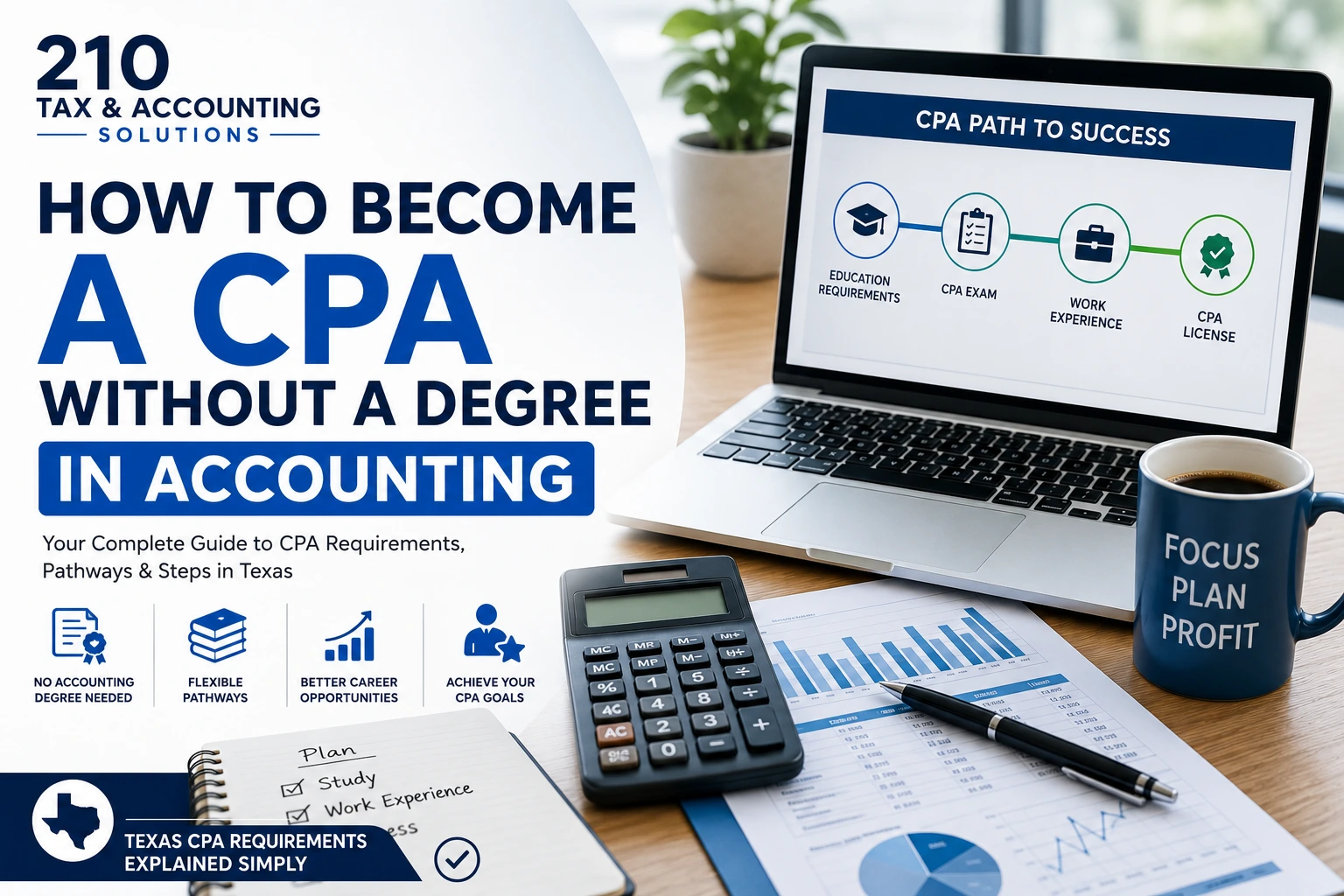
If you’ve searched this question, you’ve probably run into two different, contradictory answers: one says only five states let you become a CPA without an accounting degree, and Texas isn’t one of them. Another says Texas requires “a degree” and stops there, as if that settles it. Neither answer is quite right, and the confusion comes from two different questions getting mixed together: “Do I need a degree at all?” versus “Does my degree have to be in accounting?” In Texas, the answer to the first question is yes. The answer to the second is no. This guide untangles exactly what that means, and covers a genuinely new development: Texas just created a second path to CPA licensure that lowers the credit-hour requirement entirely, effective August 1, 2026.
The Real Answer: Texas Doesn’t Require an Accounting Major
The Texas State Board of Public Accountancy (TSBPA) requires a bachelor’s degree or higher from a board-recognized institution, but that degree does not have to be titled “Accounting.” What actually matters is the coursework you complete, not the name printed on your diploma.
Under the traditional path (which remains fully available), to sit for the CPA Exam you need:
- A baccalaureate or graduate degree from a TSBPA-recognized institution, in any field
- At least 120 semester hours of college coursework
- At least 21 semester hours of upper-level accounting coursework
- At least 24 semester hours of upper-level business coursework, including two hours of accounting or business communications
To move from passing the exam to actually holding your CPA certificate, you’ll additionally need:
- A total of 150 semester hours of college credit
- A three-semester-hour board-approved ethics course
- One year of work experience under a licensed CPA
- A passing score on the Rules of Professional Conduct exam
Notice what’s not on that list: a declared accounting major. If you already have a bachelor’s degree in business, finance, economics, or almost any other field, you don’t need to go back and earn a second degree. You need to complete the specific accounting and business credit hours the TSBPA requires, which you can generally do through additional coursework at an accredited university or community college, without re-enrolling in a full degree program.
Breaking: Texas’s New 120-Hour Pathway (Effective August 1, 2026)
Here’s something most guides on this topic won’t tell you, because it’s genuinely new. On May 14, 2025, the AICPA and NASBA jointly approved a national framework letting states offer an alternative to the long-standing 150-hour rule. Texas moved on it: under Senate Bill 262, the state created a second licensure route, referred to as Pathway B, that takes effect on August 1, 2026.
Pathway B lets you qualify for the CPA Exam and eventual licensure with:
- A baccalaureate degree from a board-recognized institution, in any field
- 120 semester hours of college coursework (not 150)
- At least 24 semester hours of upper-level accounting coursework
- At least 21 semester hours of upper-level business coursework
- The same three-semester-hour ethics course required under the traditional path
- Two years of work experience under a licensed CPA (instead of one year)
In plain terms: Pathway B trades 30 fewer credit hours of college coursework for one additional year of supervised work experience. The traditional 150-hour path (Pathway A) hasn’t gone anywhere, it’s still fully available, and for some candidates it may still make more sense. But if the idea of an extra, often costly fifth year of college has been the thing standing between you and sitting for the CPA Exam, this changes that calculation for the first time in decades.
If you’re planning your coursework now and want to take advantage of Pathway B before its official effective date, the TSBPA has an Election Form process available for applications submitted between October 9, 2025 and July 31, 2026, worth confirming directly with the Board if your timeline falls in that window, since the exact hour breakdown during the transition period differs slightly from the standard post-August 2026 requirements.
Step-by-Step: How to Become a CPA in Texas Without an Accounting Degree
1. Confirm your current credit hours against TSBPA requirements
Pull your college transcript and compare it against the accounting and business coursework hours listed above. Most non-accounting graduates are missing the upper-level accounting hours specifically, not the total credit count.
2. Choose your pathway
Decide between the traditional 150-hour path (Pathway A, one year of experience) and the new 120-hour path (Pathway B, two years of experience, effective August 1, 2026). Your decision should weigh how much additional coursework you’re missing against how much work experience you’re willing to commit to.
3. Complete the missing coursework
Take the specific upper-level accounting and business courses you’re short on. This can typically be done through individual courses at an accredited college or university, in person or online, without pursuing a second full degree.
4. Apply to sit for the CPA Exam
Once your coursework requirements are met, submit your application to the TSBPA and register for the Uniform CPA Examination, which is identical across all states regardless of which education pathway you used to qualify.
5. Pass all four exam sections
The CPA Exam includes three core sections, Auditing and Attestation (AUD), Financial Accounting and Reporting (FAR), and Taxation and Regulation (REG), plus one discipline section you choose from Information Systems and Controls (ISC), Business Analysis and Reporting (BAR), or Tax Compliance and Planning (TCP). You need a score of at least 75 on each section, and sections generally must be passed within a rolling window.
6. Complete your work experience requirement
Work under the direct supervision of a licensed CPA for one year (Pathway A) or two years (Pathway B). This experience is typically verified directly by your supervising CPA as part of your license application.
7. Complete your ethics course and apply for licensure
Finish the three-semester-hour board-approved ethics course, submit your application for the CPA certificate, and pay the applicable certification and licensing fees.
Why Non-Accounting Majors Face a Harder CPA Exam, and How to Plan Around It?
Passing the coursework requirement is only part of the challenge. If your background isn’t in accounting, the CPA Exam itself tends to hit differently than it does for someone who just finished an accounting degree.
- Uneven foundation across sections. If your career or coursework leaned toward finance or tax, you may walk in stronger on Regulation but weaker on Auditing or Financial Accounting, and vice versa depending on your background. Plan extra study time specifically for your weaker sections rather than spreading preparation evenly.
- Time away from formal study. The exam changes regularly to reflect new accounting standards, audit requirements, and tax law. The longer it’s been since you were last in a classroom, the more current material you’ll need to catch up on, independent of how strong your underlying knowledge is.
- Rebuilding study stamina. Sitting for long, intensive exam sections after years away from academic testing takes real conditioning. Non-traditional candidates often do better easing into shorter, frequent study sessions before ramping up to longer ones, rather than assuming they can pick up where a four-year degree left off.
None of these are reasons not to pursue the CPA. They’re reasons to build a study plan that accounts for your specific starting point rather than following a generic study schedule built for a 22-year-old accounting graduate.
About 210 Tax & Accounting Solutions
This guide is brought to you by 210 Tax & Accounting Solutions, a San Antonio, Texas-based firm providing tax preparation, accounting, bookkeeping, payroll, and IRS resolution services to individuals and small businesses across the city. We work with clients directly, not through a rotating call center or a national franchise, so whether you’re navigating your own CPA licensure path or just need your books and taxes handled by people who know San Antonio, you’ll always know exactly who’s helping you.
Beyond CPA career guidance, our team handles the full range of accounting and tax work San Antonio individuals and businesses need day to day:
- Bookkeeping: Monthly bookkeeping that keeps your books accurate and current, the foundation everything else is built on.
- Payroll Services: Payroll handled correctly and connected directly to your books, not managed in a separate system.
- QuickBooks Setup: A QuickBooks file set up right the first time, by the same team that will use it for your ongoing books.
- Financial Statement Preparation: Lender- and investor-ready statements built on books you can trust.
- CFO / Controller Services: Fractional CFO and Controller support for businesses ready to move past reactive bookkeeping.
- Nonprofit Accounting: Fund accounting and Form 990 support for San Antonio nonprofits, no revenue minimum.
Visit us to learn more about 210 Tax & Accounting Solutions and the full range of tax and accounting services we provide.
Frequently Asked Questions
Do I need a degree in accounting to become a CPA in Texas?
No. You need a bachelor’s degree or higher in any field from a board-recognized institution, plus specific upper-level accounting and business coursework. The degree itself doesn’t need to be titled “Accounting.”
Can I become a CPA in Texas with absolutely no college degree?
No. Texas requires at least a baccalaureate degree under both the traditional path and the new Pathway B option. There’s no experience-only substitute for the degree requirement itself.
What is Texas’s new 120-hour CPA pathway?
Effective August 1, 2026, Texas Senate Bill 262 creates a second licensure route requiring 120 semester hours of college coursework (instead of 150) combined with two years of supervised work experience (instead of one). The existing 150-hour, one-year-experience path remains fully available as well.
How many accounting credit hours do I actually need if my degree isn’t in accounting?
Under the traditional path, you need at least 21 semester hours of upper-level accounting coursework to sit for the exam, and 24 semester hours of accounting coursework total for licensure, plus 24 semester hours of upper-level business coursework. Under the new Pathway B, the requirement is at least 24 semester hours of upper-level accounting coursework and 21 semester hours of upper-level business coursework.
Can I complete the missing accounting coursework without earning a second degree?
Yes. Most non-accounting graduates complete the required courses individually at an accredited university or community college rather than pursuing a second bachelor’s degree.
Is the CPA Exam harder if I didn’t major in accounting?
It can be more challenging in specific ways, particularly in sections that don’t align with your professional background, but it isn’t a different exam. Building a study plan around your actual strengths and gaps, rather than a generic schedule, is the more useful way to think about the difficulty.